
Compare RV Insurance Quotes: How to Evaluate Policies, Pricing Logic, and Hidden Risk Before You Buy
Compare RV Insurance Quotes: How Smart Buyers Evaluate Policies Before They Commit
The wrong insurance quote rarely feels wrong — until it is tested by a major loss.
Comparing RV insurance quotes is not a shopping exercise. It is a financial risk decision that determines how well your protection holds up after an accident, weather event, theft, or liability claim.
Two policies can appear nearly identical on a quote screen yet behave very differently when a claim is filed. Pricing varies because insurers are not simply selling coverage — they are modeling exposure based on how your RV is stored, driven, valued, and insured.
Most buyers focus on the monthly premium.
Underwriters focus on probability of loss.
The space between those two perspectives is where expensive mistakes are made.
This guide explains how to compare RV insurance quotes the way insurance professionals evaluate them — so you choose a policy that survives real-world pressure, not just one that looks attractive online.
Why RV Insurance Quotes Vary More Than Buyers Expect
Many shoppers assume quotes should land within a narrow range.
In reality, a $900 annual quote and a $2,100 quote can both be correctly priced.
Insurance carriers calculate premiums using layered risk models that incorporate dozens of variables.
Primary Drivers Behind Quote Differences
- RV class and size
- Replacement cost
- Rv insurance cost
- Usage pattern (recreational vs full-time)
- Driver history
- Storage exposure
- Territory risk
- Liability selection
- Deductible structure
Adjust even one of these variables and the entire pricing structure can shift.
For example, storing a motorhome indoors in a low-catastrophe region may dramatically reduce comprehensive risk compared to outdoor storage in a hail-prone territory — even if the RV is rarely driven.
Many carriers quietly re-tier policyholders after rating updates or minor violations, something buyers often discover only when premiums change at renewal.
Understanding pricing logic transforms quote comparison from guesswork into controlled decision-making.
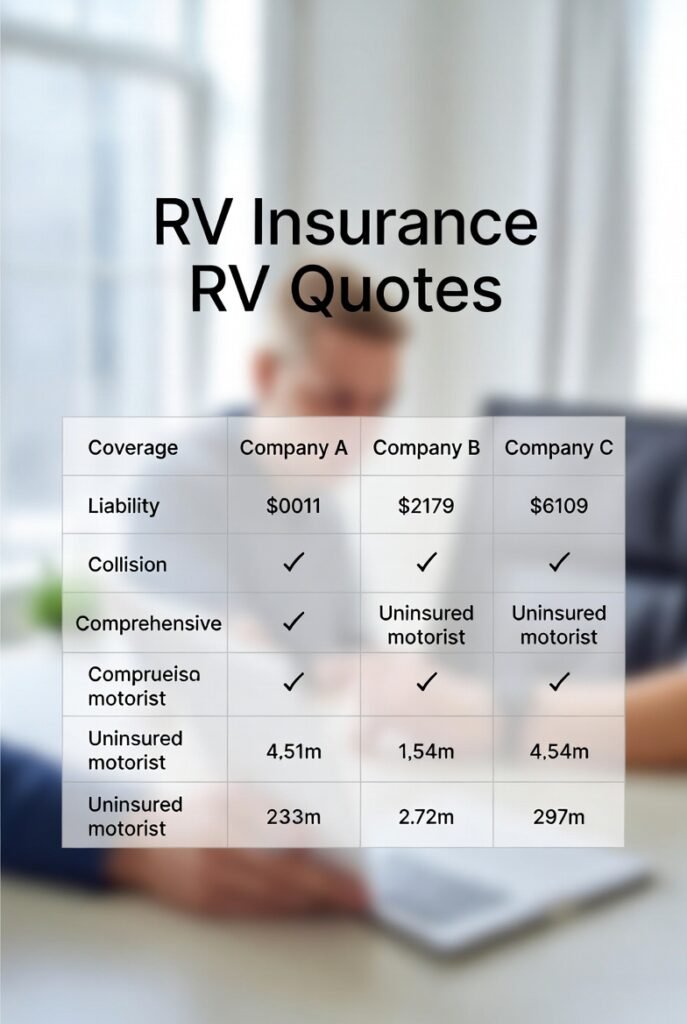
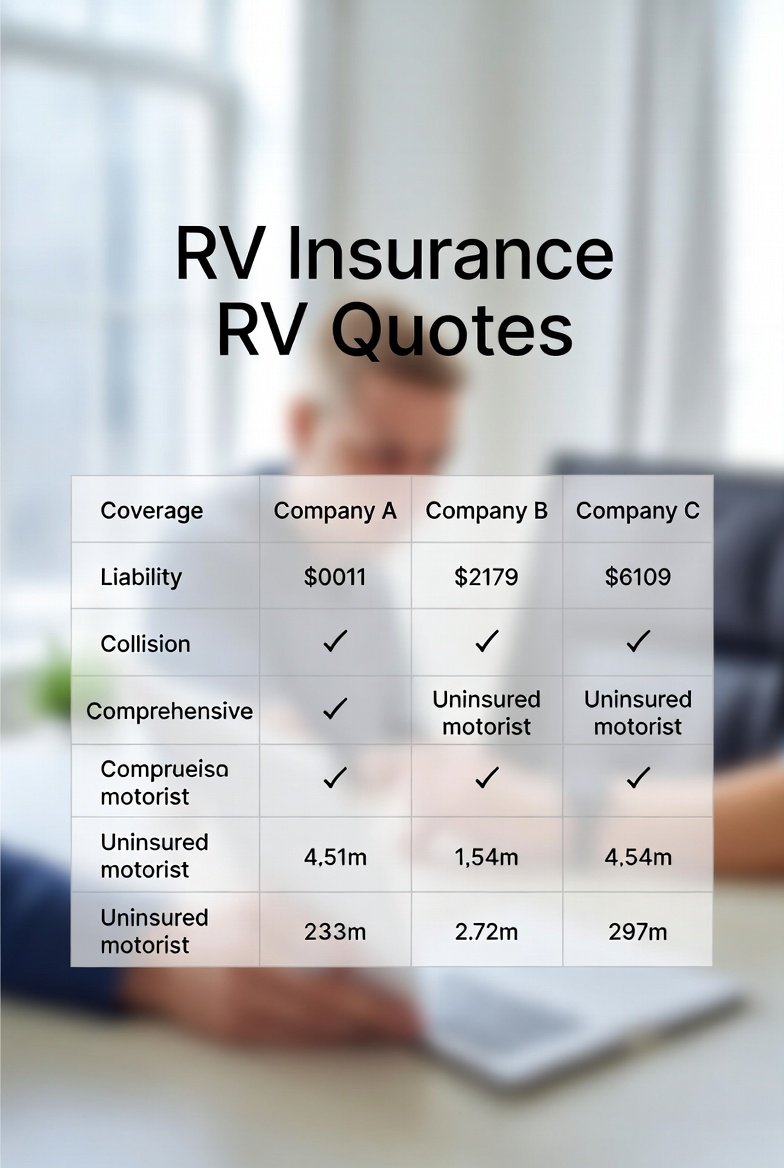
The RV Insurance Quote Comparison Matrix
Compare how a policy behaves — not just what it costs.
Evaluation Factor — What to Look For — Why It Matters
- Liability limits — Minimum vs protective thresholds — Low limits expose savings, income, and future earnings
- Valuation method — Agreed value vs actual cash value — Determines payout after total loss
- Deductible structure — Balanced vs excessively high — Cheap premiums often shift risk to you
- Usage classification — Recreational vs full-time — Misclassification is a common denial trigger
- Garaging address — Accurate storage location — Adjusters often verify this early
- Endorsements — Emergency expense, roadside, personal effects — Prevents coverage gaps
- Claims reputation — Adjuster quality and responsiveness — Critical during high-stress events
- Exclusions — Weather, flood, wear-related limits — Often buried in policy language
A quote is only competitive if it remains protective after these filters.
A Realistic Quote Comparison Scenario
Consider a late-model Class C motorhome stored indoors and used seasonally.
Quote — Annual Premium — Valuation — Deductible — Hidden Tradeoff
- Quote A — $1,040 — Actual cash value — $1,000 — Depreciation could reduce payout significantly
- Quote B — $1,420 — Agreed value — $1,000 — Higher premium but predictable settlement
- Quote C — $1,160 — Agreed value — $2,500 — Lower premium shifts more risk to owner
Quote A appears cheapest — until depreciation removes tens of thousands from a total-loss settlement.
Quote C looks efficient — until a major claim requires a large immediate out-of-pocket payment.
This is why smart comparison focuses on financial outcome, not entry price.

How Underwriters Actually Price Your Quote
Insurance pricing is probability math.
Carriers estimate how likely you are to generate a claim — and how expensive that claim could be.
Core Rating Variables
RV Type
Large motorhomes create higher severity risk due to repair complexity.
Replacement Value
Advanced electronics and custom interiors raise loss exposure.
Usage Pattern
Full-time occupancy increases liability and property risk.
Driver Profile
Even minor violations can influence rating tiers.
Storage Conditions
Indoor storage reduces theft and weather exposure.
Territory
Wildfire, flood, and hail zones typically produce higher comprehensive rates.
Adjusters often review storage disclosures early in significant claims because garaging inconsistencies can signal underwriting misalignment.
When quotes differ dramatically, it usually reflects how a carrier interprets one of these variables — not random pricing.
Online Quote vs Agent Quote — Knowing When Precision Matters
Online quoting platforms are efficient, but they rely on simplified assumptions.
Agents refine risk data.
Online Quotes Are Often Suitable When:
- The RV is used recreationally
- Storage is straightforward
- Coverage needs are conventional
- Driver history is clean
Agent Guidance Becomes Valuable When:
- You live in the RV full-time
- The vehicle is heavily customized
- Ownership involves an LLC or trust
- Travel spans multiple regions
- Higher liability thresholds are needed
Skipping agent input in complex situations can produce policies that appear valid but perform poorly during claims.
The Most Common Quote Comparison Mistake
Buyers frequently compare:
Premium vs premium
Instead of:
Protection vs exposure
Lower premiums are often achieved by:
- Increasing deductibles
- Reducing liability
- Changing valuation methods
- Removing endorsements
- Narrowing coverage
Cheap is not inherently risky.
Unexamined cheap is.
Deductible Engineering: The Lever That Quietly Reshapes Risk
Deductibles influence both affordability and financial shock after a loss.
A higher deductible reduces premium — but increases immediate out-of-pocket responsibility.
Decision Rule
Choose a deductible you could comfortably cover within 24–48 hours without destabilizing your finances.
If a $2,500 deductible would create stress, it is not a savings strategy — it is deferred financial pressure.
Experienced RV owners often balance deductibles to maintain both premium stability and emergency flexibility.
Valuation Methods That Quietly Control Settlement Size
One of the most misunderstood areas of RV insurance.
Actual Cash Value (ACV)
Pays market value after depreciation.
Agreed Value
Locks in a predetermined payout.
Replacement Cost
Typically applies to newer units and may replace with a comparable model.
Selecting the wrong valuation structure can create a five-figure recovery gap after a total loss.
Always verify the valuation method explicitly — never assume.
Hidden Triggers That Commonly Lead to Claim Denials
Denials rarely appear without warning signs. They usually trace back to inaccurate policy data.
Watch for these high-risk errors:
- Garaging Misrepresentation
- Usage Misclassification
- Undisclosed Drivers
- Customization Gaps
- Business Use
- RV insurance exclusion
Claims adjusters evaluate these factors early because inconsistencies often shape coverage interpretation.
Verification prevents surprises.
When Multiple Quotes Look Similar — How Experts Break the Tie
If competing quotes cluster within a narrow price range, shift your focus to quality indicators.
Prioritize:
- Claims handling reputation
- Coverage clarity
- Endorsement depth
- RV insurance add -ons explained
- Financial strength
- Adjuster responsiveness
In serious claims, execution quality matters more than minor premium differences.
A slightly higher premium paired with stronger claims performance often produces the better long-term outcome.
The Smart Buyer’s Quote Verification Workflow
Before committing, confirm these elements:
✔ Liability limits align with your financial exposure
✔ Valuation method is clearly stated
✔ Deductibles match your emergency capacity
✔ Storage address is accurate
✔ Usage classification reflects reality
✔ Drivers are fully disclosed
✔ Endorsements close meaningful gaps
✔ Exclusions are understood
Think of this as underwriting alignment rather than paperwork.
Risk Tolerance Strategy: Aligning Coverage With Financial Comfort
Insurance decisions ultimately reflect how much uncertainty you are willing to absorb.
Buyer Profile — Recommended Strategy
- Risk-averse — Higher liability limits + agreed value
- Cheap RV Insurance Strategies
- Balanced — Moderate deductible with strong endorsements
- Budget-focused — Careful deductible increase without reducing liability
- Full-time RVer — Residential-level liability and broader protections
Policies should reflect your financial resilience — not just your monthly budget.
Strategic Ways to Improve Quote Quality
Stronger quotes are often engineered intentionally.
Consider:
- Bundling policies
- Completing RV safety programs
- Installing anti-theft devices
- Choosing secure storage
- Maintaining strong credit
- Avoiding small claims
Insurers reward predictability.
Limitations and Drawbacks of Quote Comparison
Even disciplined comparison has boundaries.
Quotes are snapshots.
Carrier availability varies.
Policy language governs coverage.
Renewal pricing can change.
Comparison improves outcomes — it does not eliminate uncertainty.
The Decision Signal Many Buyers Miss
A strong policy is not the cheapest.
It is the one that still feels sufficient when you imagine the worst plausible scenario.
Picture a total loss.
Picture a serious liability claim.
Would the policy still protect your financial position?
If yes, the comparison was done correctly.
Final Perspective
Comparing RV insurance quotes is less about shopping and more about aligning protection with exposure.
Approach the process like a risk evaluation:
Understand pricing.
Verify structure.
Confirm details.
Stress-test coverage.
When a quote survives that scrutiny, it stops being a number — and becomes a financial safeguard.