
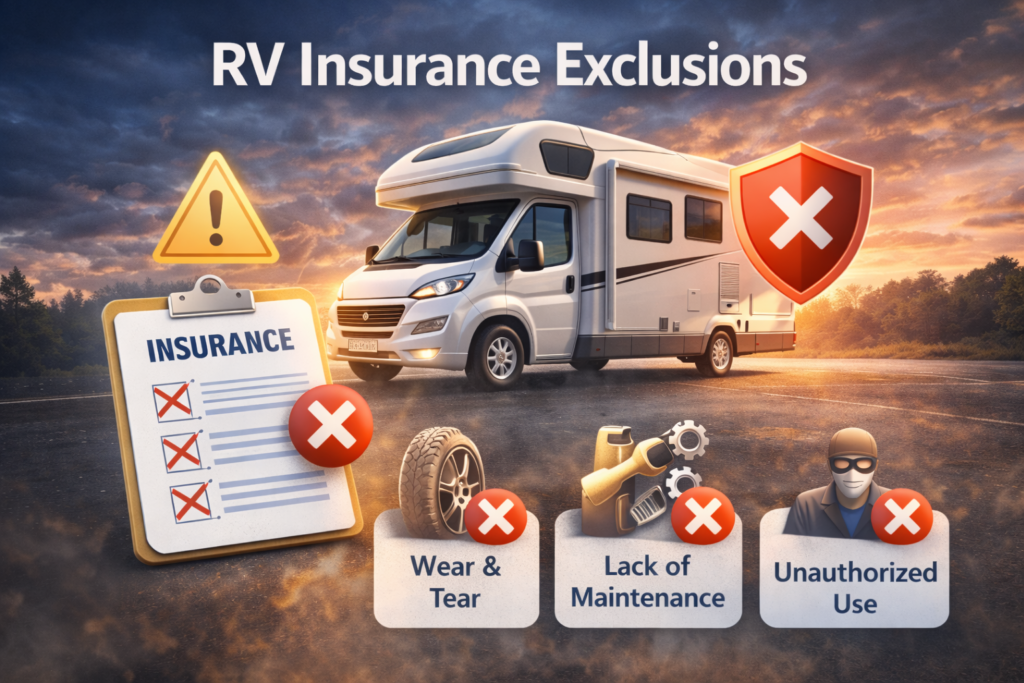
RV Insurance Exclusions: Why Some RV Insurance Claims Get Denied
A strong storm passes through a campground overnight.
The next morning an RV owner notices water dripping from the ceiling. The roof membrane has cracked and rainwater slowly leaked into the interior.
Repair estimate: $9,400.
The owner files an insurance claim expecting comprehensive coverage to pay for repairs.
But the insurer denies the claim.
The reason?
The adjuster determines the damage was caused by long-term roof deterioration rather than sudden storm damage.
Situations like this illustrate one of the most misunderstood parts of RV coverage: insurance exclusions.
RV insurance covers many risks, but every policy also defines situations where coverage does not apply. Understanding those exclusions is critical for avoiding denied claims and unexpected repair costs.
Most Common RV Insurance Exclusions
Most RV insurance policies exclude predictable types of damage or loss.
Typical RV insurance exclusions include:
- wear and tear or aging components
• mechanical breakdown or equipment failure
• gradual water damage
• improper storage or neglect
• undeclared equipment or modifications
• intentional damage
• illegal activity involving the RV
Understanding these exclusions helps RV owners identify coverage gaps before a claim occurs.
To understand how base RV policies work before exclusions apply, see:
rv-insurance-coverage-explained
Why RV Insurance Claims Actually Get Denied
Insurance companies rarely deny claims randomly. Most denials fall into predictable categories.
Cause-of-loss disputes
Insurance covers sudden accidents, not gradual deterioration. If adjusters believe damage developed slowly, claims may be rejected.
Maintenance classification
Damage caused by lack of maintenance may be classified as owner responsibility rather than an insured loss.
Usage mismatch
If an RV is used as a full-time residence but insured as recreational use, the policy may not respond as expected.
Undeclared equipment
Custom upgrades not listed in the policy may receive limited or no reimbursement.
Understanding these situations helps RV owners avoid common coverage disputes.
Covered vs Excluded RV Damage Examples
The difference between covered and excluded damage often depends on how the damage occurred.
Damage Event | Coverage Outcome |
Collision with another vehicle | Usually covered |
Tree branch punctures roof during storm | Often covered |
Aging roof seals leak during rain | Often excluded |
Engine or generator failure | Usually excluded |
RV damaged during illegal activity | Often excluded |
Plumbing leak over several months | Often excluded |
The cause of damage, not just the damage itself, determines how insurance responds.
Wear and Tear Exclusions
Insurance policies typically exclude normal aging or deterioration.
Examples include:
- cracked roof seals from age
• worn tires that fail during travel
• aging plumbing components
• faded or deteriorating exterior materials
These problems develop gradually and are classified as maintenance issues rather than accidents.
Gradual Water Damage
Water damage is one of the most common causes of denied RV insurance claims.
The key factor insurers investigate is whether the damage occurred suddenly or gradually.
Situation | Coverage Likelihood |
Storm punctures roof membrane | Often covered |
Roof seal slowly deteriorates over years | Often excluded |
Burst plumbing pipe damages interior | Often covered |
Slow plumbing leak behind cabinets | Often excluded |
Gradual leaks often lead to claim disputes.
Mechanical Breakdown Exclusions
Most RV insurance policies exclude mechanical failures.
Examples include:
- engine failure
• transmission breakdown
• generator malfunction
• appliance failure
Insurance covers accidents, not mechanical wear.
Extended warranties or service contracts sometimes cover these repairs.
Improper RV Use
RV insurance policies define acceptable vehicle use.
If an RV is insured as recreational but used as a permanent residence, coverage conflicts may occur.
Full-time RV policies provide broader protection similar to homeowners insurance.
Coverage add-ons that address these gaps are explained here:
rv-insurance-add-ons-explained
Custom Equipment and Modification Exclusions
Many RV owners install additional equipment such as:
- solar panel systems
• satellite internet systems
• upgraded electrical systems
• custom storage equipment
If these upgrades are not declared in the policy, reimbursement may be limited after damage.
Always verify how modifications are listed in the policy.
Intentional Damage and Illegal Activity
Insurance policies universally exclude intentional damage.
Examples include:
- deliberate vandalism by the owner
• fraudulent claims
• damage occurring during illegal activity
If investigators determine intentional actions caused damage, the insurer may deny the claim.
Deductibles and Claim Payout Limitations
Even when damage is covered, the deductible determines whether insurance pays anything.
Example scenario:
Repair cost: $900
Policy deductible: $1,000
Insurance pays nothing because the repair cost is below the deductible threshold.
Deductibles and their impact are explained here:
Add-On Coverage That Reduces Exclusion Risk
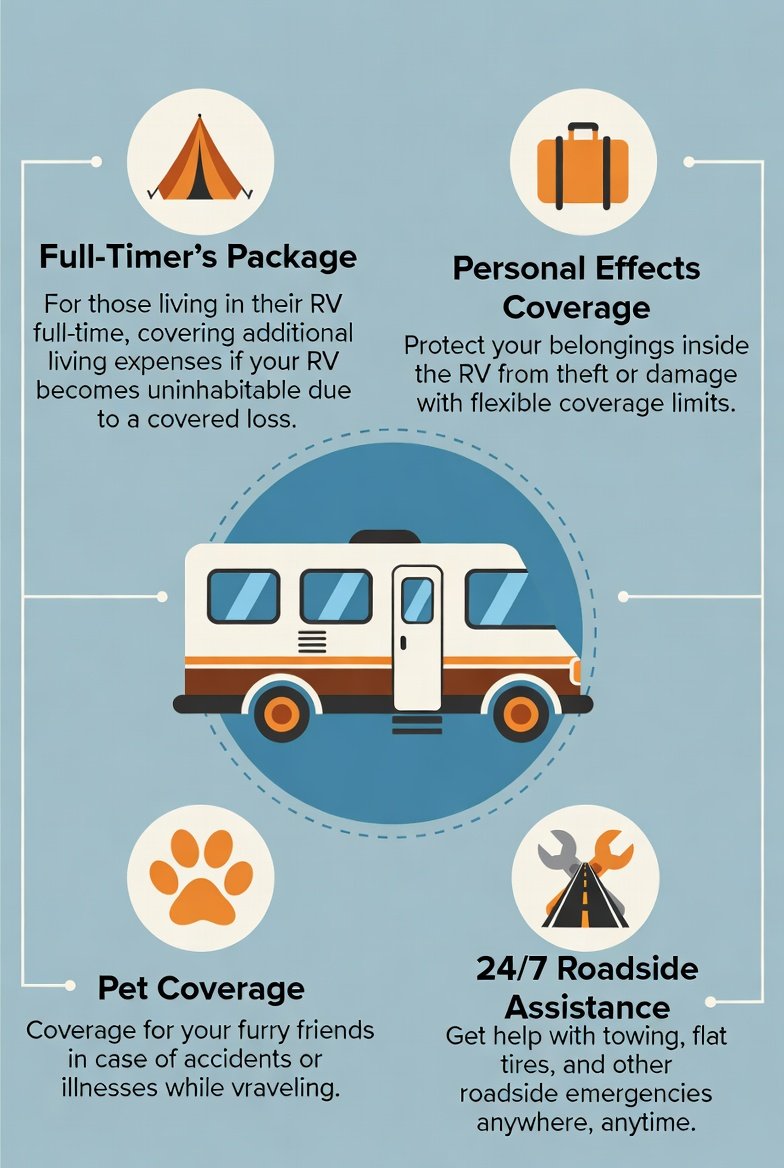
Certain policy add-ons help close common coverage gaps.
Coverage Gap | Add-On Solution |
Personal belongings theft | Personal effects coverage |
Campsite liability incidents | Vacation liability coverage |
Roadside breakdowns | RV roadside assistance |
Long-term storage risks | Storage coverage options |
These options extend protection beyond basic RV insurance policies.
Real Claim Denial Scenarios
Understanding common denial situations helps RV owners avoid costly mistakes.
Scenario 1 — Roof leak claim
A long-term roof seal deterioration causes interior water damage.
Outcome: claim denied due to maintenance classification.
Scenario 2 — Equipment not declared
A solar system installed on the roof is damaged during a storm.
Outcome: reimbursement limited because the system was not declared in the policy.
Scenario 3 — Incorrect policy type
An RV used as a full-time residence carries recreational coverage only.
A liability claim occurs at a campsite.
Outcome: coverage dispute due to usage mismatch.
Verification Checklist Before Filing an RV Insurance Claim
Before filing a claim, verify the following:
Verification Step | Why It Matters |
Damage occurred suddenly | Gradual damage may be excluded |
RV maintenance records exist | Demonstrates responsible ownership |
Policy type matches RV usage | Prevents coverage disputes |
Equipment upgrades declared | Ensures reimbursement |
Deductible exceeds repair cost | Determines claim viability |
This verification process can prevent unnecessary claim denials.
Related RV Insurance Guides
If you are comparing coverage options or trying to understand RV insurance policies, these guides explain the full picture.
This internal structure strengthens the RV insurance knowledge cluster, helping readers move from understanding coverage rules to comparing policies.
FAQ
What does RV insurance usually exclude?
RV insurance commonly excludes wear and tear, mechanical breakdown, gradual damage, intentional damage, and losses caused by improper use.
Why do RV insurance claims get denied?
Claims are often denied when the damage falls under policy exclusions or when insurers determine the loss resulted from maintenance issues rather than sudden accidents.
Is water damage covered by RV insurance?
Water damage may be covered if it results from sudden events such as storms. Gradual leaks caused by aging components are usually excluded.
Does RV insurance cover mechanical breakdown?
Most RV insurance policies exclude mechanical breakdown because it is considered a maintenance issue rather than an accidental loss.
Can exclusions vary between insurers?
Yes. Coverage exclusions and conditions vary between insurers, policy types, and state regulations.