
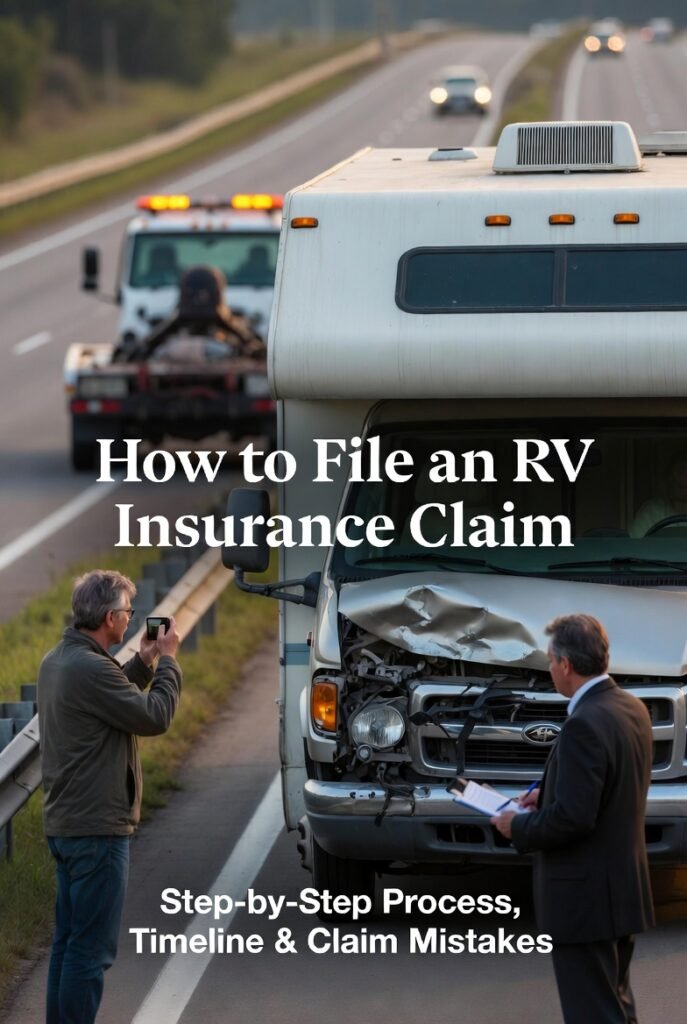
How to File an RV Insurance Claim: The Real Process Behind Insurance Payouts
Many RV owners think filing a claim is straightforward.
Damage happens.
You call the insurer.
A payment follows.
But RV insurance claims do not work like automatic reimbursements.
Before paying, the insurer has to confirm:
- what caused the damage
- whether the policy covers that type of loss
- how the deductible applies
- and how much the insurer is actually responsible for paying
That is why the claim process matters.
If you understand the process before filing, you are less likely to make mistakes that slow the claim down or weaken it.
Quick Answer
To file an RV insurance claim, report the incident to your insurer as soon as possible, document the damage with photos and details, cooperate with the adjuster’s review, submit repair estimates if requested, and complete the settlement process based on the policy’s coverage and deductible.
What Is an RV Insurance Claim?
An RV insurance claim is a formal request asking the insurer to pay for a covered loss involving the RV, such as collision damage, weather damage, theft, vandalism, or certain liability events. The claim process exists to verify whether the policy applies, what the damage is worth, and what portion of the loss the insurer will pay.
Understanding How RV Insurance Claims Actually Work
A claim is not just “damage + payment.”
It is a review process.
The insurer is trying to answer three questions:
- Is this event covered?
- How much damage is related to that event?
- What amount should be paid after the deductible and policy terms are applied?
That is why coverage type matters.
If you are unsure how RV policies separate collision, comprehensive, and liability events, the guide at
rv-insurance-coverage-explained
helps clarify which kinds of losses usually fall into each category.
Claim Filing Decision Map
Before filing, most RV owners need clarity on three points.
- Is the damage large enough to justify a claim?
Small losses below or near the deductible may not be worth filing. - What coverage applies?
The event has to match the policy’s covered cause of loss. - Did the incident begin as a breakdown rather than a damage claim?
If so, roadside help may matter before the insurance claim does.
The breakdown guide at - rv-emergency-coverage explains how roadside assistance fits into these situations.
This decision step is important because not every problem with an RV should become an insurance claim.
When You Should File an RV Insurance Claim
Filing usually makes sense when the loss is meaningful, clearly covered, or involves other people.
Common examples include:
- major collision damage
- theft or attempted theft
- vandalism
- severe hail or storm damage
- fire damage
- falling object damage
- liability incidents involving another person or another vehicle
These are the kinds of losses policies are generally designed to respond to.
If the RV was parked during the incident, storage-related coverage may matter.
The guide at
explains how parked-RV coverage works during storage periods.
When Filing a Claim May Not Make Sense
Not every problem should be filed as a claim.
Situations where filing may not make sense include:
- damage below the deductible
- very minor cosmetic damage
- wear-and-tear issues
- maintenance-related failures
- small repair costs you can handle out of pocket
If the repair cost is close to the deductible, the claim may produce little or no payout.
That does not mean “never file small claims.”
It means the owner should first compare:
- expected repair cost
- deductible amount
- claim value after deductible
The deductible guide at
rv-insurance-deductibles-explained
is useful here because deductible size directly affects whether a claim is financially worthwhile.
Step-by-Step: How to File an RV Insurance Claim
Most RV insurance claims follow a similar structure, even when the exact insurer process varies.
Step 1 — Notify the Insurance Company
The first step is reporting the incident.
This can usually be done through:
- an online claim portal
- a mobile app
- a phone call to the insurer’s claims department
The insurer will usually ask for:
- policy number
- date and location of the incident
- short description of what happened
- photos if available
- contact details
Prompt reporting helps the insurer begin the review while the facts are still fresh.
Step 2 — Document the Damage and Incident
This is where many weak claims start to fall apart.
Strong documentation usually includes:
- wide photos of the scene
- close photos of the damage
- date and location details
- witness information if relevant
- police report for theft or certain accidents
- repair estimates or repair-shop notes
Good documentation makes it easier for the adjuster to connect the event to the damage.
Step 3 — Work With the Claims Adjuster
After the claim is opened, the insurer usually assigns a claims adjuster.
The adjuster’s role is to review:
- cause of loss
- coverage applicability
- extent of damage
- estimated repair value
This review may happen:
- in person
- by photo review
- at an RV repair facility
- through a mix of these methods
The adjuster is not there just to “approve payment.”
The adjuster is there to verify what the policy actually owes.
Step 4 — Review Repair Estimates
Once the damage is confirmed, repair estimates are reviewed.
The insurer may:
- accept an estimate from the chosen shop
- request a second estimate
- direct the owner to a preferred repair network
- ask for additional inspection if the repair is large or complicated
RVs often need specialized repair facilities because they combine:
- body panels
- structural elements
- electrical systems
- plumbing systems
- appliances
- slide-out components
That complexity can slow the process compared with a normal car claim.
Step 5 — Finalize the Settlement
Once the amount is approved, the insurer calculates the settlement.
That amount depends on:
- repair cost
- coverage limits
- deductible
- any exclusions or policy limits affecting the claim
The payment may go to:
- the repair facility
- the RV owner
- or both, depending on the claim setup
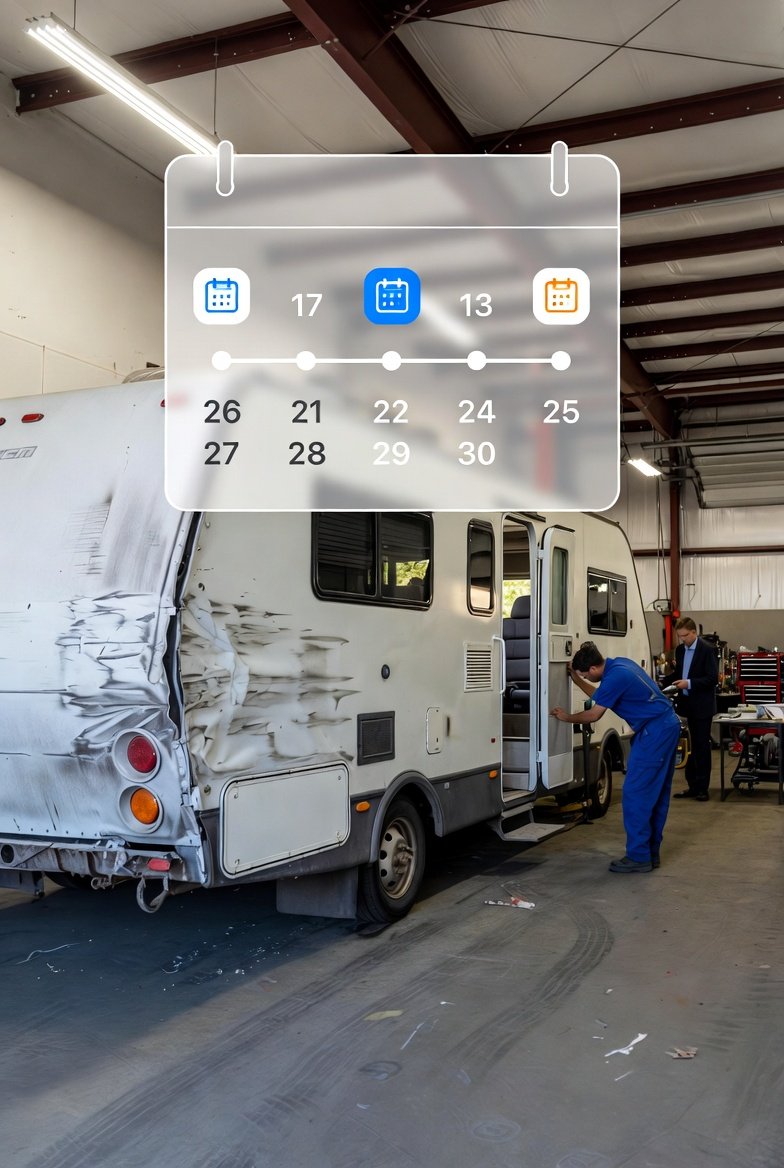
Typical RV Insurance Claim Timeline
Claim Stage | Typical Time |
Claim filed | Same day |
Adjuster assigned | 24–72 hours |
Inspection scheduled | 2–5 days |
Repair estimate review | 3–10 days |
Settlement or payment | Varies |
Straightforward claims can move faster.
Large structural repairs, disputed causes of loss, or parts delays can stretch the process significantly.
RV Insurance Claim Documentation
Google and users both respond well to clear process tables, so this should be explicit.
Document | Why It Matters |
Photos of damage | Helps verify the loss and severity |
Photos of the scene | Helps show how the incident happened |
Police report | Supports theft, vandalism, or accident details |
Repair estimate | Helps confirm repair cost |
Witness statements | Supports the event description |
Policy information | Helps confirm coverage and deductible |
This table also makes the claim process easier to scan.
Will Filing an RV Insurance Claim Increase Your Premium?
Sometimes yes. Sometimes no. But it can affect renewal pricing.
Premium impact often depends on:
- number of claims
- severity of the loss
- whether fault was involved
- the insurer’s underwriting rules
- prior claim history
A single claim does not automatically mean a dramatic rate increase.
But repeated claims, large payouts, or a pattern of losses can matter more at renewal.
This is another reason owners should think before filing very small claims.
The right question is not just:
“Can I file?”
It is also:
“Should I file this claim, given the deductible and the likely payout?”
Common RV Insurance Claim Mistakes
Several common mistakes weaken claims or create unnecessary delays.
Claim Mistake | Why It Causes Problems |
Reporting too late | Makes the loss harder to verify |
Weak photo evidence | Leaves room for dispute |
Not understanding coverage | Damage may not qualify |
Incomplete repair estimate | Slows review |
Forgetting deductible impact | Creates payout surprises |
Mixing maintenance with insured damage | Leads to claim confusion |
This is one of the most important sections on the page because many denied or frustrating claims begin with simple misunderstandings.
Common Reasons RV Insurance Claims Are Denied
Claims are not denied randomly. They are usually denied because the insurer says the loss does not meet the policy conditions.
Situation | Possible Reason |
Damage excluded by the policy | Coverage limitation |
Mechanical failure only | Maintenance issue, not insured event |
Reporting delay | Verification becomes harder |
Missing documentation | Insufficient proof |
Undisclosed modifications | Policy mismatch |
Pre-existing damage | Claim does not match the reported event |
That does not mean every denial is correct.
It means RV owners should build the claim carefully from the beginning.
Real Adjuster-Style Example
Example: Collision Claim
An RV backs into a fixed object and causes $4,500 in damage.
The policy includes collision coverage with a $1,000 deductible.
The adjuster confirms:
- the damage matches the reported event
- the repair estimate is valid
- the policy covers the loss
In that case, the insurer may pay $3,500 after the deductible is applied.
This example is simple, but it shows how claims actually work:
covered loss – deductible = expected payout basis
Example RV Claim Scenarios
Campground Collision
An RV hits a utility post while backing into a campsite.
Collision coverage usually responds if the policy includes it.
Storm Damage
A hailstorm damages the roof and exterior panels while the RV is parked.
Comprehensive coverage usually applies to weather-related damage.
Storage Facility Vandalism
An RV in long-term storage is vandalized during winter.
Coverage depends on whether comprehensive protection remained active while stored.
The storage guide at
explains how stored-RV coverage affects these situations.
Breakdowns That Turn Into Claims
Some events begin as roadside problems and then become insurance matters.
For example:
- a breakdown leads to towing
- a tire event causes secondary damage
- a roadside incident exposes another covered problem
In those cases, it helps to understand what roadside assistance does versus what the insurance policy does.
The guide at
explains where that line usually sits.
RV Claim Filing Checklist
Before submitting a claim, verify:
- the damage appears covered
- the deductible amount
- photos and evidence are ready
- incident details are accurate
- repair estimate or repair-shop notes are available
- police report is collected if needed
This short checklist reduces sloppy claims.
FAQ
How long does an RV insurance claim take?
Many RV insurance claims start moving within a few days, but full resolution depends on inspection, repair complexity, and parts or shop delays.
Do I need photos to file an RV insurance claim?
Photos are strongly recommended because they help verify the damage, the scene, and the cause of loss.
Can RV insurance claims be denied?
Yes. Claims may be denied if the damage is excluded, documentation is weak, reporting is delayed, or the event does not meet policy conditions.
Should I file an RV insurance claim for minor damage?
Not always. If the repair cost is below or close to the deductible, filing may not make financial sense.