
Best RV Insurance Companies: How to Choose the Right Provider for Your RV Type, Usage, and Risk
Best RV Insurance Companies: How to Choose the Right Provider (Without Falling for Marketing-Driven Rankings)
A weak RV policy usually doesn’t reveal itself until a five-figure repair or liability claim forces the contract to perform.
That is why choosing the best RV insurance company is not about brand familiarity or attractive premiums — it is about selecting a carrier whose policy structure holds up when financial exposure becomes real.
Because the truth most buyers discover too late is this:
The best provider for a weekend travel trailer is rarely the best provider for a financed Class A motorhome.
The best option for a full-time RVer is often unnecessary — and overpriced — for someone who stores their rig half the year.
This guide is not a popularity list.
It is a decision framework designed to help you evaluate insurers the way risk professionals do — by focusing on valuation methods, liability structure, underwriting alignment, and claim behavior.
Price is not proof.
Coverage wording is everything.
Your usage details quietly determine how a claim unfolds.
A Quick Reality Check Before Evaluating Any RV Insurer
Some coverage features separate strong RV policies from generic vehicle-style insurance.
Programs built specifically for RV ownership may offer valuation structures such as total loss replacement, along with options like vacation liability, emergency expense, and full-timer liability depending on eligibility and state availability.
These are not comfort features.
They are financial shock absorbers.
Without them, the policy that looked perfectly adequate on purchase day can behave very differently after a major loss.
Large motorhome repairs alone can escalate quickly due to specialty parts, labor intensity, and limited repair networks — one reason valuation structure matters far more in RV insurance than many buyers initially assume.
How “Best” Should Actually Be Defined in RV Insurance
An insurer is only “best” when it aligns with four realities:
- Your RV type — motorhome, travel trailer, fifth wheel, or camper
- Your usage pattern — recreational vs full-time
- Your financial exposure — assets worth protecting
- Your tolerance for out-of-pocket risk
This means there is rarely a universal winner.
Instead, strong providers tend to excel in specific scenarios:
- Broad protection for typical RV owners
- Specialized coverage for full-time lifestyles
- Discount-driven pricing structures
- Service-oriented claim environments
- Multi-carrier comparison access
Choosing correctly is less about finding the biggest name — and more about matching underwriting expectations with how your RV is actually used.
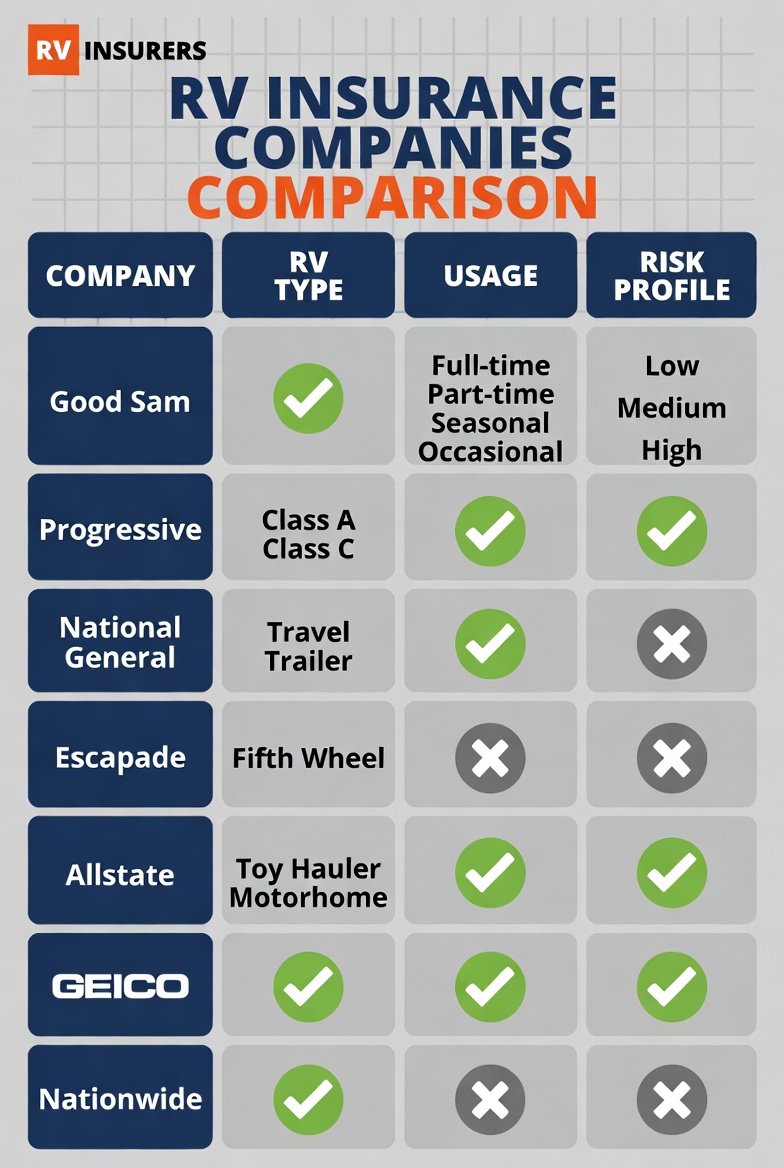
The Decision Matrix: Best RV Insurance Companies by Scenario
Use this matrix as a filtering tool before requesting quotes.
Provider Type — Best For — Why It Fits — What to Verify
- Major carrier with RV program — Most owners seeking balanced protection — Often combines stability with RV-specific endorsements — Valuation method and deductible structure
- RV-specialty insurer — Full-timers or complex ownership — Coverage designed around lifestyle risk — Usage classification accuracy
- Discount-focused carrier — Clean drivers bundling policies — Potentially strong pricing leverage — Liability limits are not reduced
- Comparison channel — Buyers wanting multiple quotes quickly — Saves time during early research — Final underwriting carrier
A provider is only competitive if the policy remains protective after these checks.
Why Carrier Choice Matters More in RV Insurance Than Auto Insurance
RV losses tend to be:
- Higher in severity
- More complex to evaluate
- Slower to repair
- Dependent on specialty components
Large motorhome damage can approach total-loss thresholds faster than many passenger vehicles.
That is why experienced adjusters often focus early on valuation structure and usage classification — because those elements heavily influence settlement direction.
Choosing the right carrier is less about convenience and more about financial survivability.
Top RV Insurance Providers — And Who Each One Fits
The companies below consistently appear across major industry comparisons and buyer research flows. They are presented here as decision tools — not marketing-driven rankings.
Progressive — Strong All-Around Fit for Many RV Owners
Quick verdict:
A reliable starting point if you want a carrier experienced in RV coverage structures.
Where it tends to perform well
- Policies often include RV-focused coverage options rather than stripped-down vehicle insurance
- Valuation structures may include replacement-style options depending on eligibility
- Broad footprint makes quoting accessible
Ideal for
- Owners seeking balanced protection
- Buyers who want modern policy features
- RVers who prefer a well-established carrier
- RV Insurance strategies
What to verify
- Exact valuation method
- Eligibility for replacement-style coverage
- Deductible balance
Many carriers quietly adjust pricing tiers after loss-trend updates, which is why renewal reviews are just as important as the original quote comparison.
National General — Strong Choice for Specialized RV Coverage
Quick verdict:
Often a natural fit when RV living introduces complexity beyond occasional travel.
Where it tends to perform well
- Coverage structures designed with RV usage in mind
- Options that may address personal effects, liability exposure, and RV Insurance costs
- Programs that anticipate longer travel patterns
Ideal for
- Full-time RVers
- Owners carrying valuable onboard property
- Buyers prioritizing endorsement depth
What to verify
- Coverage limits on bundled protections
- Storage disclosures
- Full-time classification
Policies must reflect reality — misalignment here is one of the most common triggers behind coverage disputes.
Nationwide — Strong Candidate for Bundling and Discounts
Quick verdict:
Worth evaluating if pricing efficiency is a priority and your profile qualifies for multiple discounts.
Where it tends to perform well
- Bundled policy opportunities
- Stable underwriting posture
- Attractive rates for lower-risk drivers
Ideal for
- Multi-policy households
- Recreational RV users
- Buyers seeking pricing balance
What to verify
- Liability thresholds remain protective
- Deductibles are not excessively high
- Endorsements match your travel behavior
Lower premiums should reflect risk efficiency — not reduced protection.
Auto-Owners — Often Favored by Buyers Who Value Service Stability
Quick verdict:
A strong consideration for buyers who prioritize predictability over aggressive pricing.
Where it tends to perform well
- Service-oriented reputation signals
- Conservative underwriting style
- Less emphasis on flashy pricing
Ideal for
- Risk-aware buyers
- Owners wanting fewer surprises
- Those comfortable working through agents
What to verify
- State availability
- Endorsement depth
- Claim workflow expectations
Consistency during a claim is often worth more than marginal premium savings.
Good Sam — Useful as a Multi-Carrier Access Point
Quick verdict:
Effective for generating quotes quickly — provided you verify the final policy details.
Where it tends to perform well
- Streamlined comparison process
- RV-focused buyer funnel
- Access to multiple underwriting paths
Ideal for
- Early-stage comparison
- Buyers unsure where to start
- Owners seeking efficiency
What to verify
- The underwriting carrier
- Valuation structure
- Coverage exclusions
Always evaluate the policy — not just the channel that delivered it.
Allstate — Strong Option for Lifestyle-Oriented Coverage
Quick verdict:
Can be a compelling fit when coverage extends beyond vehicle risk into lifestyle exposure.
Where it tends to perform well
- Options resembling residential liability structures
- Emergency expense style protections
- Coverage that anticipates extended stays
Ideal for
- Owners spending significant time in their RV
- Buyers seeking broader liability framing
What to verify
- State availability
- Personal property limits
- Claim handling expectations
Lifestyle coverage should match how you actually live — not how the application describes you.
Still Unsure? Use This Fast Decision Filter
Choose the provider aligned with your highest-risk variable:
- Full-time living → prioritize liability depth
- Expensive motorhome → prioritize valuation structure
- Frequent travel → prioritize emergency protections
- Higher net worth → prioritize stronger liability limits
When uncertainty exists, protect the downside first.
The Coverage Checklist That Separates “Best” From “Good Enough”
Before binding a policy, confirm:
- Liability limits capable of protecting assets
- Explicit valuation method
- Balanced deductibles
- Accurate garaging address
- Correct usage classification
- Driver disclosure
- Endorsement clarity
- Exclusion awareness
Serious RV liability claims can reach six figures when injuries are involved, which is why many experienced owners carry higher limits than state minimums.
Where Most Buyers Misjudge “Best”
Many shoppers compare premiums instead of financial outcomes.
Common mistakes include:
- Choosing low liability thresholds
- Ignoring valuation differences
- RV Insurance Calculator
- Underreporting storage risk
- Forgetting to disclose drivers
- Overlooking modification coverage
Insurance rarely fails randomly — it fails where details were assumed instead of verified.
Claims Reality Most Lists Never Mention
Even strong carriers can deliver very different claim experiences depending on adjuster assignment and regional repair capacity.
Repair backlogs, specialty parts availability, and catastrophe volume can all influence settlement timelines.
This is another reason valuation structure and endorsement depth deserve careful attention.
Limitations of “Best RV Insurance Company” Lists
To keep expectations grounded:
- Availability varies by state
- Endorsements differ across programs
- Claim experience can be region-dependent
- Renewal pricing is not guaranteed
The best carrier is ultimately the one whose policy performs when tested.
Final Recommendation
The best RV insurance company is the one that aligns with your real-world risk — and continues to protect you when circumstances become financially uncomfortable.
Start with a focused shortlist.
Compare quotes intelligently.
Verify every structural detail.
Then choose the policy designed not just to insure your RV — but to protect your financial trajectory.
Because the strongest policy is not the cheapest.
It is the one that still looks adequate on the worst day you can realistically imagine.