
Camper Insurance Cost: Real Price Ranges, What Drives Your Rate, and a Simple Premium Estimator
Camper insurance cost is not built from one national average. It’s built from underwriting math.
Insurers aren’t asking, “What does camper insurance usually cost?”
They’re asking:
How often will this camper generate a claim, and how expensive will that claim be?
That’s why two owners with “similar campers” can see premiums hundreds (or thousands) of dollars apart—because their risk structure is different: storage location, storm exposure, theft risk, how the camper is used, what it’s worth, and what the policy actually covers.
This page gives you decision-grade clarity:
- Realistic price ranges by camper type
- The pricing levers that actually move premiums
- A simple estimator that predicts your likely band before you quote
- A coverage package matrix so quotes are comparable
- A verification checklist that prevents claim friction and denial triggers
- A balanced limitations section so you don’t over-trust averages
Understanding “Camper” Insurance: Towable vs Motorized
Before you price anything, you must separate the two worlds:
- Towable campers (pop-ups, travel trailers, fifth wheels, many truck campers depending on setup)
- Motorized campers (campervans/Class B and motorhomes)
Why this matters: motorized units carry auto-style liability exposure every mile you drive. Towables often have different liability handling (sometimes through the towing vehicle policy), but physical damage protection still matters for theft, hail, fire, and total loss.
If you don’t separate these categories, you’ll compare quotes that are structurally different—and the “cheapest” quote will usually be missing something important.
Camper Insurance Cost: Realistic Pricing Bands by Type
Most SERP pages throw one blended number.
Better approach: pricing bands by category, because severity potential is different.
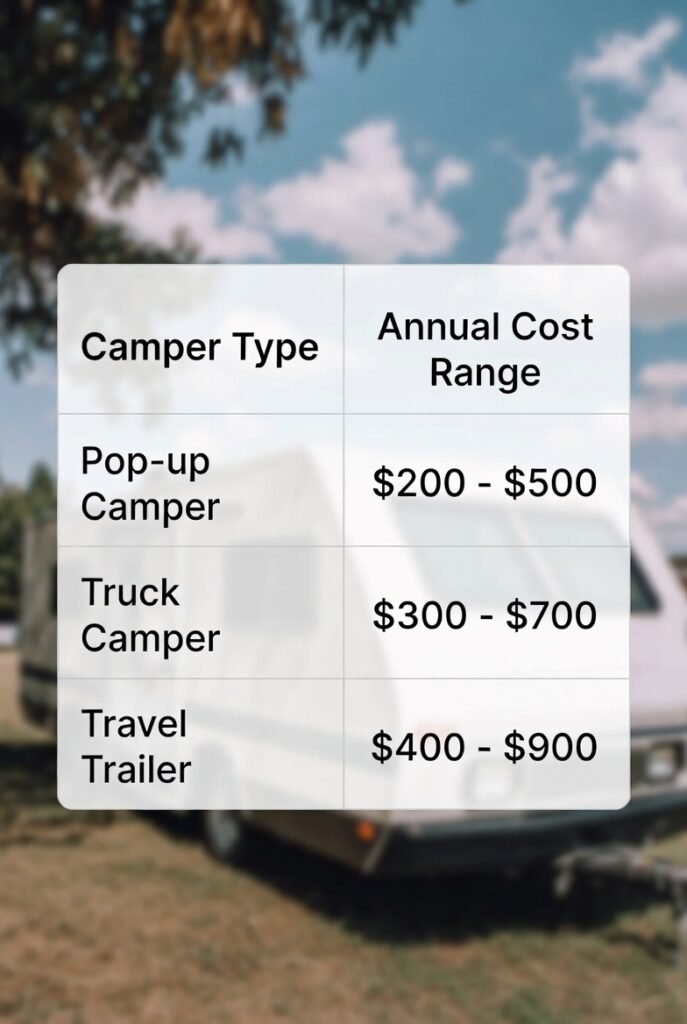
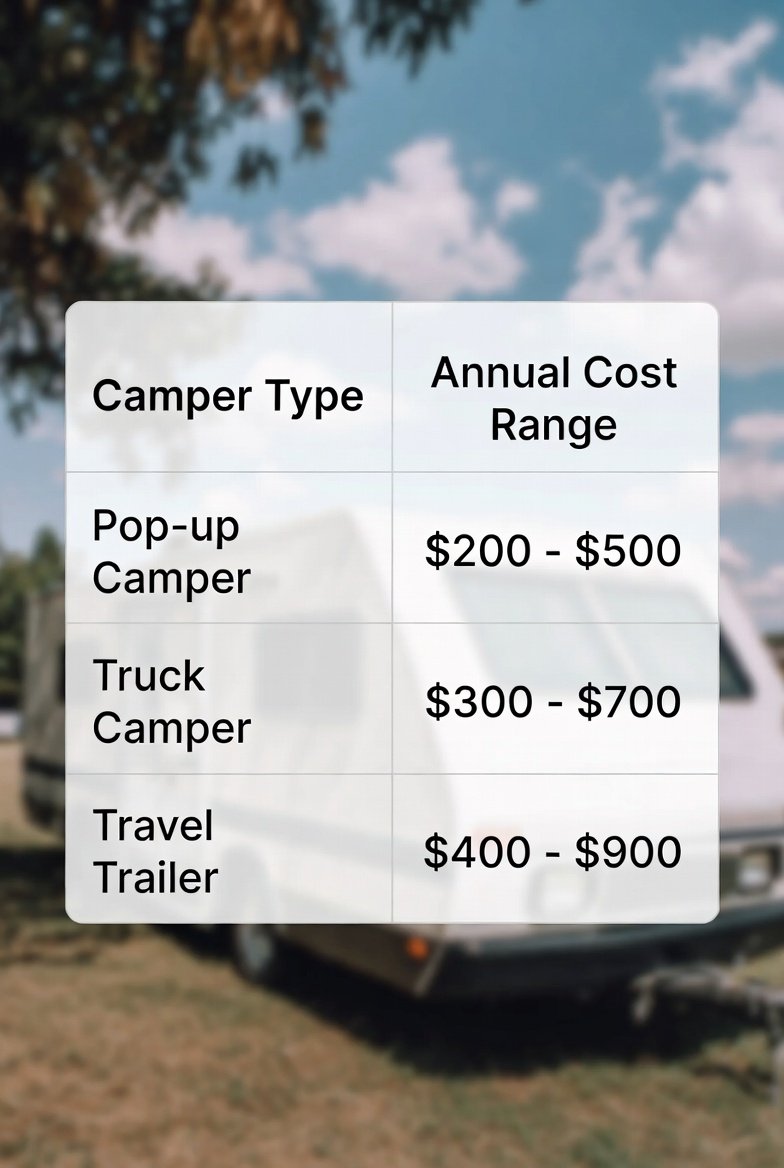
Typical Annual Camper Insurance Pricing Bands
Camper Type | Typical Annual Range | Why This Prices This Way |
Pop-Up / Folding Camper | $150 – $450 | Lower replacement cost, lower claim severity |
Teardrop Camper | $200 – $550 | Small footprint, limited repair totals |
Travel Trailer | $300 – $900 | Theft + storm surface area + higher values |
Fifth Wheel | $400 – $1,400 | Higher values, larger losses (hail/total loss) |
Truck Camper | $150 – $500+ (varies) | Depends heavily on value + documentation + storage |
Campervan / Class B (Motorized) | $500 – $1,500+ | Motorized liability + repair inflation + conversion value |
Full-Time Use (Any Type) | Often 25–50% higher | Residential-style liability and continuous exposure |
A price anchor you can sanity-check: Progressive reports a 2024 average annual premium of $594 for a travel trailer and $1,052 for a motorhome.
These are not guarantees. They’re reality anchors—use them to spot when your quote is unusually low (missing coverage) or unusually high (risk trigger or wrong classification).
The Underwriting Equation: Why Your Camper Premium Moves
Insurers price using two forces:
1) Claim Frequency
How often claims happen.
- Theft-prone storage areas
- High traffic miles
- Busy campgrounds / long seasons
- More time “in use” vs stored
2) Claim Severity
How expensive claims become.
- Higher camper value and upgrades
- Repair labor rates in your area
- Storm exposure (hail / wind / fire)
- Liability payouts (especially motorized)
When both rise together—high frequency and high severity—your premium climbs fast.
The 7 Pricing Drivers That Matter Most
1) Camper Value (and How You Prove It)
Higher values raise comprehensive and collision pricing. Custom interiors, solar builds, lithium systems, electronics—these matter.
What to verify:
How is the camper valued in a total loss?
- Actual Cash Value (ACV)
- RV Insurance Cost
- Agreed Value
- Replacement / Total Loss Replacement
If you can’t explain your valuation method, you don’t actually know what you bought.
2) Storage Location
Where it sits most nights can matter more than where you travel.
- Coastal wind zones
- Hail corridors
- Wildfire regions
- Theft-heavy metro storage
- RV Insurance coverage
What to verify:
The garaging/storage address is accurate and acceptable.
3) Usage Pattern
Pricing changes if you’re:
- Weekend / seasonal user
- Extended traveler
- Full-time user
What to verify:
Full-time status must match reality. Misclassification is a common claim dispute trigger.
4) Deductibles (Especially Comprehensive)
Lower deductibles raise premiums; higher deductibles reduce them—but shift more cost to you after a loss.
What to verify:
Are there special wind/hail deductibles or separate deductibles by peril?
5) Liability Limits
This is where many buyers under-protect themselves.
Higher limits cost more—but the value is massive in a serious injury claim.
What to verify:
Your liability selection is intentional, not default.
6) Driver / Operator Profile
Tickets, claims, and lapse history move rates. For motorized units, this behaves like auto underwriting.
What to verify:
All drivers are properly disclosed.
7) Theft / Storm Add-Ons and Endorsements
Roadside assistance, personal effects, emergency expenses, attached accessories—these raise premiums but prevent expensive gaps.
What to verify:
What’s included and what’s optional.
Coverage Package Matrix (So Quotes Are Comparable)
Most people get burned because they compare “cheap” to “complete” without realizing it.
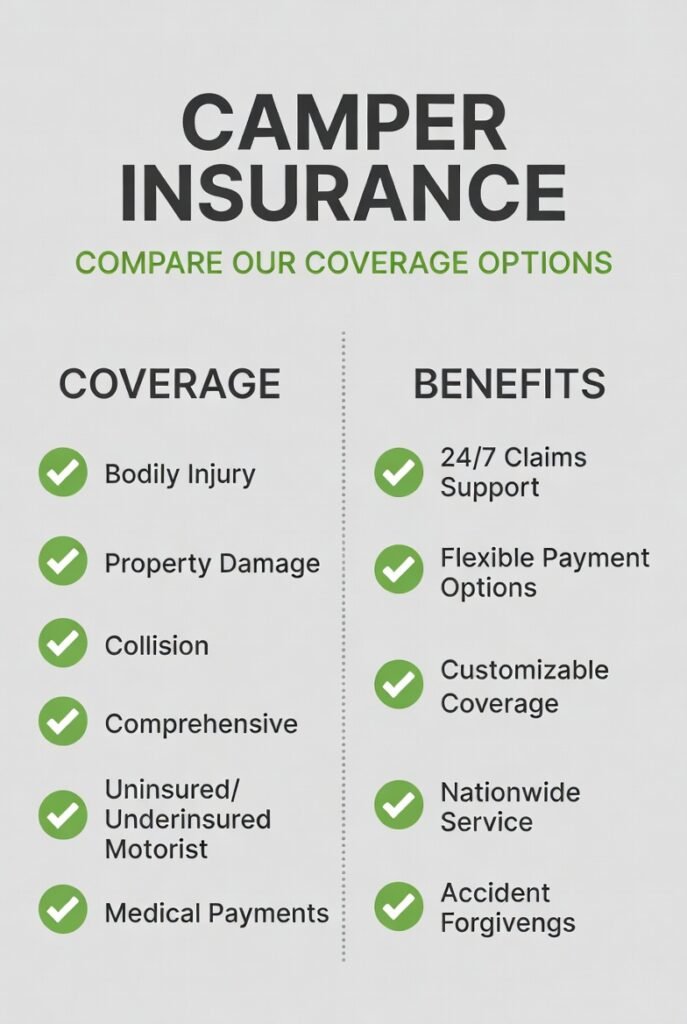
Camper Insurance Coverage Packages
Package | Who It Fits | What It Usually Includes | The Hidden Risk | Verify This Before Buying |
Minimum | Low-value campers, indoor storage | Minimal physical damage or liability-only | Theft / hail / total loss out-of-pocket | Confirm theft & total loss handling |
Balanced | Most owners | Liability + comp/collision + reasonable deductibles | ACV depreciation shock | Confirm valuation + deductibles |
Strong | High-value rigs, storm zones | Higher liability + lower comp deductible + add-ons | Higher premium (usually justified) | Roof, water, named peril rules |
If your quote is dramatically lower than expected, you’re usually looking at Minimum while thinking you’re buying Balanced.
The Premium Estimator (Fast, Practical)
Step 1: Start With Type
Pop-up → lower band
Travel trailer / fifth wheel → mid-band
Motorized → higher band
Step 2: Add Storage Risk
Indoor → down
Outdoor / storm zone → up
Step 3: Add Usage
Seasonal → steady
Extended / full-time → up
Step 4: Choose RV Insurance Deductibles
Higher → premium down
Lower → premium up
Step 5: Choose Liability
Higher limits → moderate increase
Minimum limits → risk up
Rule:
If two or more drivers push upward, expect the top half of the band.
Denial and Dispute Triggers (What Actually Goes Wrong)
- Garaging Misrepresentation
- Full-Time Use Hidden as Recreational
- Valuation Confusion
- Roof / Water Intrusion Limits
- Undisclosed Drivers
Verification prevents almost all of these.
Two Quick Scenarios
Scenario A: Travel Trailer + Outdoor Storage + Hail Zone
Higher comp pricing makes sense. Strong comprehensive coverage prevents major loss.
Scenario B: Truck Camper + Expensive Build + Weak Documentation
Without proof, insurers may undervalue it. Valuation structure matters.
Limitations / Drawbacks
These pricing bands are directional. Actual premiums depend on:
- Storage ZIP
- Valuation method
- Usage classification
- Deductibles
- Liability limits
- Driver history
- RV Insurance best company
Use this guide to structure quotes, not expect an exact number.
What to Do Next
- Decide towable vs motorized
- Choose coverage package
- Lock deductibles & liability
- Get 3 comparable quotes
- Verify storage, usage, valuation, exclusions
That’s how you avoid the cheap quote → expensive surprise pipeline.