
RV insurance coverage explained: what policies include, hidden gaps, and how to build real protection
RV insurance coverage explained — protection is architecture, not a checkbox
Most RV owners believe they understand their insurance.
Right up until they file a claim.
Coverage confusion is one of the largest hidden financial risks in RV ownership because policies often look similar while behaving very differently when something goes wrong.
Two owners can both say:
“I have full coverage.”
Yet one is financially protected…
and the other is dangerously exposed.
This guide explains RV insurance the way underwriters evaluate risk — not the simplified version shown in marketing brochures.
By the time you finish reading, you’ll understand:
- what each coverage actually protects
- where expensive gaps usually hide
- which add-ons meaningfully transfer risk
- how full-time usage changes everything
- how to structure a policy that survives real-world claims
This is not about buying more insurance.
It is about buying correct insurance.
First principle: RV insurance is built in layers
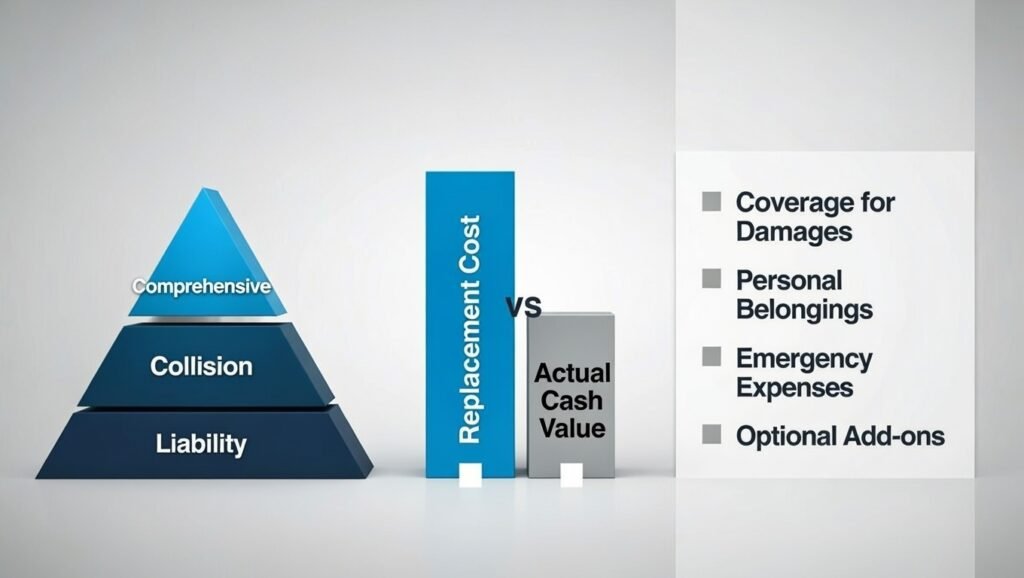
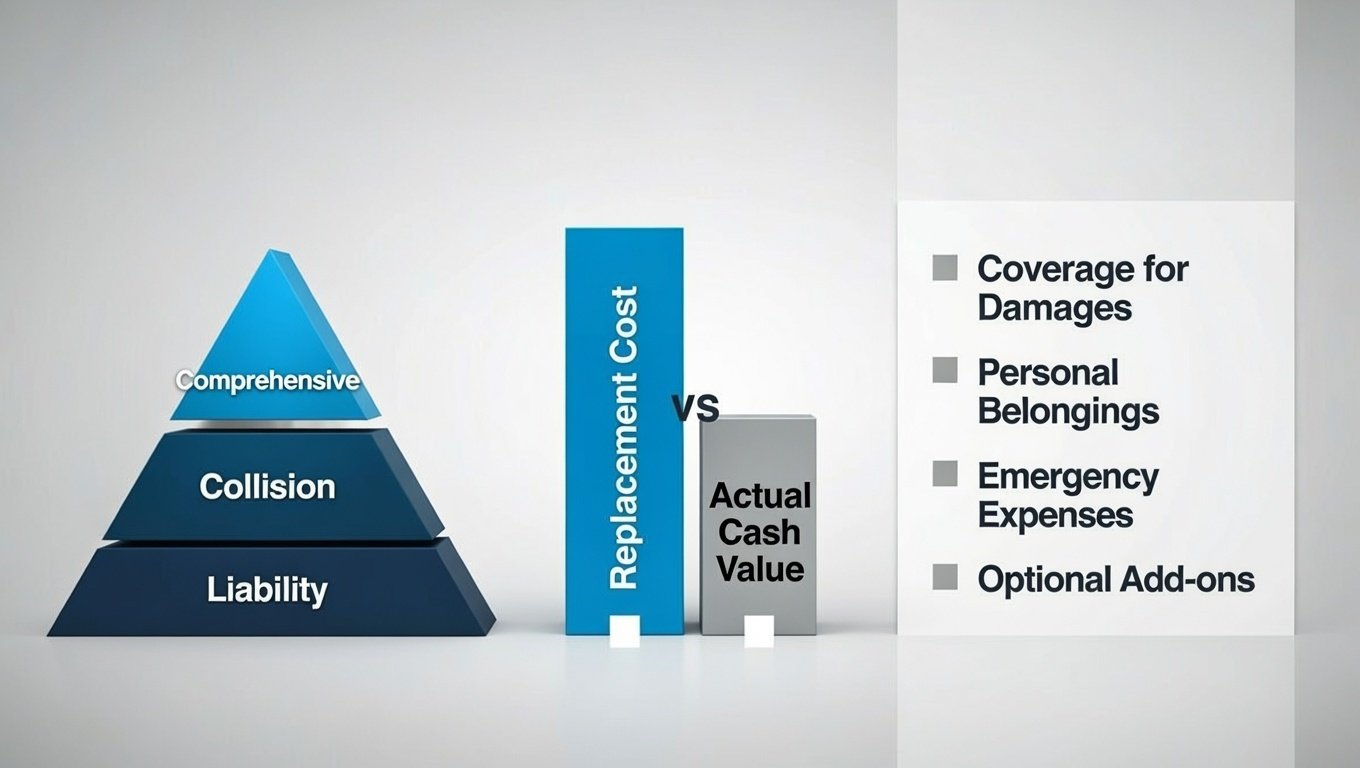
Strong policies follow a layered protection model.
Think of it less like a product — and more like a defensive system.
- Layer 1 — Liability protection (protects your financial future)
- Layer 2 — Physical damage protection (protects the RV itself)
- Layer 3 — Usage-based risk adjustment (protects how you live/travel)
- Layer 4 — Optional risk transfers (protect specific financial threats)
Coverage failures rarely happen because someone bought a “cheap” policy.
They happen because one of these layers was missing.
Liability coverage — the policy that protects your net worth
If there is one coverage you should never minimize, it is liability.
Liability pays for:
- bodily injury
- property damage
- legal defense
- settlements
- court judgments
Without adequate limits, a severe accident can become a personal financial event.
Why RV liability exposure is higher than auto
RVs introduce physics problems:
- longer stopping distances
- heavier mass
- higher repair costs
- multi-vehicle collision potential
Medical claims alone can exceed six figures quickly.
State minimum limits were never designed for RV-scale accidents.
They exist to satisfy legal requirements — not to protect wealth.
Many experienced advisors suggest thinking in terms of asset protection, not compliance.
Low liability limits are the single most common structural weakness in RV policies.
Not because owners are careless.
Because exposure is underestimated.
Collision coverage — repairing your RV after impact
Collision covers damage when your RV hits:
- another vehicle
- a structure
- a guardrail
- debris
- or rolls over
Fault typically doesn’t matter.
If impact occurs, this is the coverage that responds.
The deductible decision most owners get wrong
Higher deductibles lower premiums.
But they also raise your immediate financial burden.
A simple stress test:
“Could I comfortably write this deductible check tomorrow?”
If not — the deductible is too aggressive.
Insurance should reduce financial shock, not create it.
Comprehensive coverage — where many large claims originate
Comprehensive protects against non-collision events such as:
- theft
- vandalism
- fire
- falling objects
- severe weather
- animal strikes
- glass damage
Owners often obsess over collision risk while underestimating catastrophe exposure — especially when RVs sit outdoors for extended periods.
In hail corridors, wildfire regions, and hurricane zones, comprehensive quietly becomes one of the highest-value protections on the policy.
Full-time vs recreational coverage — one of the biggest structural divides
This is where many policies quietly break.
Standard RV insurance assumes recreational usage.
Full-time living changes the risk model entirely.
When an RV becomes your residence, exposure expands:
- visitor injuries
- delivery incidents
- campsite liability
- property-style risk
Full-time coverage behaves more like a hybrid of auto and homeowners insurance.
Attempting to classify full-time living as recreational is not just inaccurate — it can introduce serious claim friction.
Usage must match reality.
Always.
Personal belongings coverage — the mobile household problem
An RV is rarely empty.
Inside you may carry:
- electronics
- tools
- outdoor gear
- kitchen equipment
- portable offices
- clothing
Policies often include belongings protection — but limits vary dramatically.
The critical question to ask:
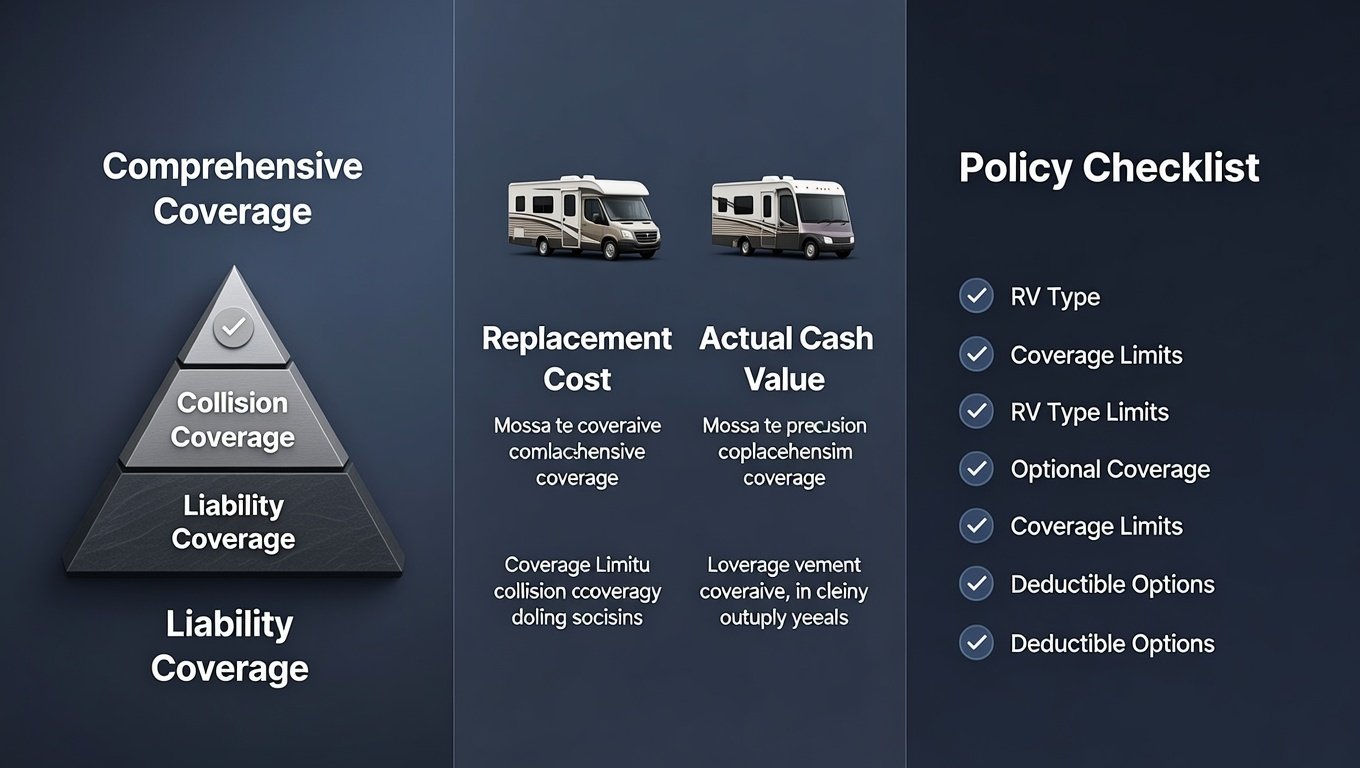
“Is this replacement cost or actual cash value?”
Depreciation can reduce payouts more than owners expect.
Anyone traveling with high-value equipment should verify limits rather than assume coverage exists.
Uninsured and underinsured motorist coverage — protection from other people’s mistakes
Not every driver carries sufficient insurance.
If someone with minimal coverage hits your RV, this protection may cover:
- medical expenses
- lost wages
- sometimes property damage
Skipping this coverage effectively means betting that every driver around you is well insured.
That is rarely a winning bet.
Relative to cost, this is one of the highest-value protections available.
Medical payments — small coverage, fast liquidity
Medical payments (MedPay) covers immediate injury expenses regardless of fault.
Typical uses:
- ambulance bills
- ER visits
- urgent treatment
It is not catastrophic protection — it is financial shock absorption.
Speed matters after accidents.
Optional coverages that often justify their cost
Not every add-on is essential.
But some transfer meaningful risk.
Roadside assistance
Specialized RV towing alone can cost dramatically more than standard vehicle recovery.
For frequent travelers, one use often offsets years of premiums.
Vacation liability
When parked, your RV functions like temporary property.
This coverage can respond if:
- someone trips near your campsite
- your pet injures someone
- minor property damage occurs
It quietly closes a real exposure gap.
Emergency expense coverage
If your RV becomes uninhabitable during a trip, this can help cover:
- lodging
- transportation
- food
Many owners only discover this coverage after needing it.
Gap coverage
RVs depreciate — sometimes faster than expected.
If totaled early in ownership, payouts based on current value may fall short of the remaining loan.
Gap coverage bridges that difference.
Especially relevant for financed RVs.
Replacement cost vs actual cash value — a decision that reshapes your risk
This is one of the most important structural choices in an RV policy.
Actual Cash Value (ACV)
Pays market value after depreciation.
Lower premiums.
Higher uncertainty.
Replacement Cost
Pays what it takes to replace the RV (within policy terms).
Higher premiums.
Lower financial shock.
Neither is universally better.
But the decision should always be intentional.
Common exclusions — where policies stop
Insurance is defined as much by what it excludes as what it covers.
Typical exclusions may include:
- wear and tear
- mechanical breakdown
- pest damage
- intentional acts
- commercial misuse
- undisclosed full-time living
Exclusions are boundaries — not tricks.
Understanding them prevents surprise.
Mini scenario — identical RVs, very different outcomes
Owner A builds a policy around price:
- low liability
- ACV valuation
- no uninsured motorist
- very high deductible
Owner B builds around risk:
- strong liability
- replacement cost
- uninsured motorist
- balanced deductible
Both say they have “full coverage.”
Only one has structural resilience.
Coverage design — not marketing language — determines protection.
How to structure a policy that actually protects you
Before finalizing coverage, confirm alignment across five drivers:
- Usage: recreational vs frequent vs full-time
- Storage: indoor vs outdoor
- Value basis: ACV vs replacement
- Deductibles: realistic tolerance
- Liability limits: aligned with assets
Cheap policies often aren’t cheap.
They’re incomplete.
When to review your coverage
Policies should evolve as your risk changes.
Review when:
- RV value increases
- travel frequency rises
- storage changes
- financial exposure grows
- you approach full-time living
Insurance should adapt alongside ownership.
Limitations worth understanding
No policy eliminates risk entirely.
Insurance transfers financial shock — it does not prevent loss.
Coverage performs best when:
- classification is accurate
- limits are adequate
- endorsements match usage
- Rv insurance per month
Structure matters more than brand.
Bottom line — coverage is architecture
RV insurance is not about selecting the longest list of protections.
It is about building a policy aligned with how you actually live and travel.
Strong coverage:
- protects assets
- reduces financial surprises
- supports recovery
Before comparing quotes, make sure you’re comparing structure — not just price.
That single shift prevents many of the coverage regrets RV owners talk about later