
Travel Trailer Insurance Cost: Real Prices, Hidden Rate Drivers, and How to Estimate Your Premium Before You Quote
Travel trailer insurance cost is one of the most misunderstood numbers in the RV world.
Not because insurers hide it — but because buyers unknowingly compare policies built on completely different risk assumptions.
Two owners can insure nearly identical trailers and see a $400 vs $1,100 premium.
That gap is rarely random.
It usually comes from one structural difference:
- Storage risk
- Trailer valuation
- Usage classification
- Deductible architecture
- Liability limits
- Coverage depth
Insurance companies are not pricing your trailer.
They are pricing the probability and severity of a future loss.
Once you understand that underwriting math, premiums stop looking unpredictable — and start looking explainable.
This guide is built as a decision engine so you can:
- Predict your likely premium band
- Avoid fragile “cheap” policies
- Prevent underwriting surprises
- Compare quotes correctly
- Buy coverage that behaves properly during a claim
The Reality Most Buyers Discover Too Late
The biggest pricing mistake isn’t overpaying.
It’s buying a policy that looks cheap but collapses under real-world conditions.
Common example:
A buyer chooses a $280 policy instead of a $520 policy.
Then a hailstorm causes $14,000 in damage…
…and the deductible plus coverage limitations turn the “cheap” policy into a five-figure mistake.
Travel trailer insurance is less about finding the lowest number — and more about building a policy that survives bad days.
Real Travel Trailer Insurance Cost (True Pricing Bands)
Ignore single-number averages. Serious buyers think in pricing bands.
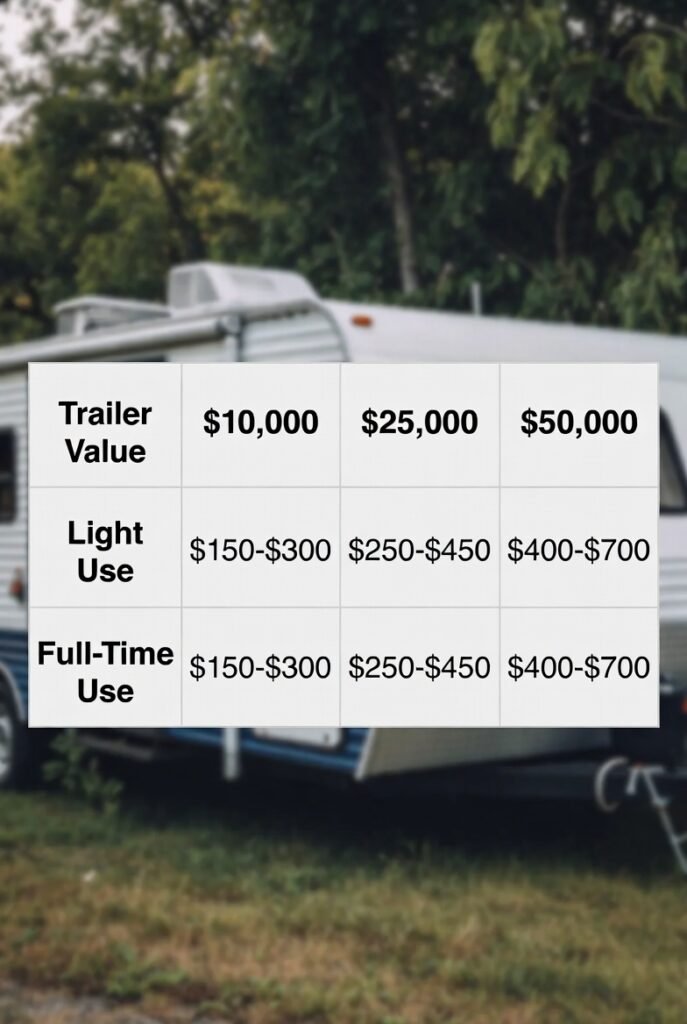
Typical Annual Travel Trailer Insurance Costs
Trailer Profile | Typical Annual Range | Primary Severity Driver |
Older / Low-value trailer | $180 – $400 | Lower replacement exposure |
Mid-value trailer | $250 – $650 | Balanced risk profile |
Newer / higher-value units | $400 – $1,000 | Repair inflation + total-loss potential |
Large / premium trailers | $700 – $1,500+ | High severity |
Full-time usage | Often 25–60% higher | Residential liability risk |
A commonly cited industry anchor places the average travel trailer premium near $594 annually.
Use it as a directional benchmark, not a guarantee.
If your quote is dramatically below that, assume something is missing until proven otherwise.
Monthly Cost Reality (Why Annual Numbers Mislead Buyers)
Buyers think monthly.
Insurers price annually.
Annual Premium | Monthly Equivalent |
$240 | $20/month |
$420 | $35/month |
$600 | $50/month |
$900 | $75/month |
$1,200 | $100/month |
The difference between weak and strong coverage is often $20–$40 per month.
That is not where financial disasters should be negotiated.
The Underwriting Equation (How Insurers Actually Think)
Every premium is built from two forces.
Claim Frequency
How often losses occur.
Raised by:
- Theft-heavy ZIP codes
- Dense storage facilities
- Frequent travel
- Long camping seasons
- Camper insurance
Claim Severity
How expensive losses become.
Raised by:
- Trailer value
- Labor rates
- Medical liability
- Storm exposure
- Fire risk
Insurers don’t price trailers.
They price loss probability.

Why Two Identical Travel Trailers Can Price $600 Apart
Trailer A
- Stored indoors
- Recreational use
- $1,000 deductible
- Moderate liability
Result: Lower premium band.
Trailer B
- Outdoor storage
- Storm-prone ZIP
- $250 deductible
- Higher liability
Result: Significantly higher premium.
Same trailer.
Different risk profile.
That’s underwriting — not inconsistency.
The Seven Variables That Move Travel Trailer Insurance Cost the Most
1. Trailer Value
Higher replacement cost = higher exposure.
Solar, lithium, custom interiors, electronics all increase severity.
Verify:
- Actual Cash Value
- Agreed Value
- Replacement Cost
- RV Insurance Cost
Never assume replacement is automatic.
2. Storage Location — The Silent Premium Multiplier
Where the trailer sleeps matters more than where it travels.
Higher-risk zones:
- Coastal wind corridors
- Severe hail regions
- Wildfire areas
- Theft-heavy metros
- RV Insurance
Indoor secured storage can materially reduce premiums.
Critical: Garaging address must match reality.
3. Usage Classification
Insurers separate:
- Recreational
- Frequent travel
- Full-time residence
Full-time use changes liability dramatically.
Misclassification is a common claim-friction trigger.
4. Deductible Architecture
Lower deductibles raise premiums.
Extreme deductibles raise risk.
Most large trailer losses are comprehensive:
- Hail
- Theft
- Fire
- Falling objects
- Exclusion
Don’t focus only on collision deductibles.
5. Liability Limits
The least visible — and most dangerous — coverage.
Serious injury claims can exceed trailer value many times over.
Higher limits usually cost far less than the protection they add.
6. Financed vs Owned Outright
Lenders often require:
- Physical damage coverage
- Lower deductibles
- Stronger valuation
This alone can raise premiums 15–40%.
7. Insurer Risk Appetite
Some carriers prefer:
- Newer trailers
- Indoor storage
- Recreational use
Others tolerate higher risk — but charge accordingly.
Premium Shock Table
Scenario | Typical Premium Impact |
Financed trailer | +15–40% |
Full-time use | +25–60% |
Storm-exposed ZIP | +10–35% |
Low deductible | +5–20% |
High-value trailer | +10–45% |
Poor storage security | Noticeable increase |
If 3+ apply, plan for the upper band.
Coverage Package Matrix (Most Important Table)
Package | Best For | What It Includes | Primary Risk |
Minimum | Older / low-value trailers | Limited damage or high deductible | Theft or storm loss becomes out-of-pocket |
Balanced | Most owners | Comp + collision, moderate deductibles | ACV depreciation surprise |
Strong | High-value / outdoor storage | Higher liability + endorsements | Higher premium, stronger claims |
If packages don’t match, price comparison is meaningless.
The Premium Estimator (Use Before You Quote)
- Start with trailer value
- Add storage risk
- Adjust for usage
- Choose deductibles
- Select liability
Rule:
If 2+ variables lean upward, assume the upper half of the pricing band.
Why Cheap Quotes Exist
Usually because:
- Physical damage is reduced
- Deductibles are elevated
- Usage is misclassified
- Storage risk understated
- Trailer value depreciated
- Endorsements missing
Cheap often means incomplete.
Denial and Claim Friction Triggers
- Garaging misrepresentation
- Full-time use marked recreational
- Valuation assumptions
- Roof / water intrusion limits
- Undisclosed drivers
Clarity prevents friction.
Limitations and Drawbacks
Pricing bands are directional, not predictive.
Actual premiums vary by:
- ZIP-level catastrophe exposure
- Driver history
- Coverage structure
- Deductible choices
- Insurer appetite
Use ranges to structure quotes — not expect guarantees.
Quick Decision Guide
Prioritize stronger coverage when:
- Trailer value is high
- Storage is outdoors
- Storm exposure exists
- Usage is extended
Lock coverage before comparing prices.
Next Steps
- Confirm storage reality
- Choose liability limits intentionally
- Decide deductible tolerance
- Select coverage package
- Request three comparable quotes
- Verify details before binding
A structured process reduces surprises and improves claim outcomes.